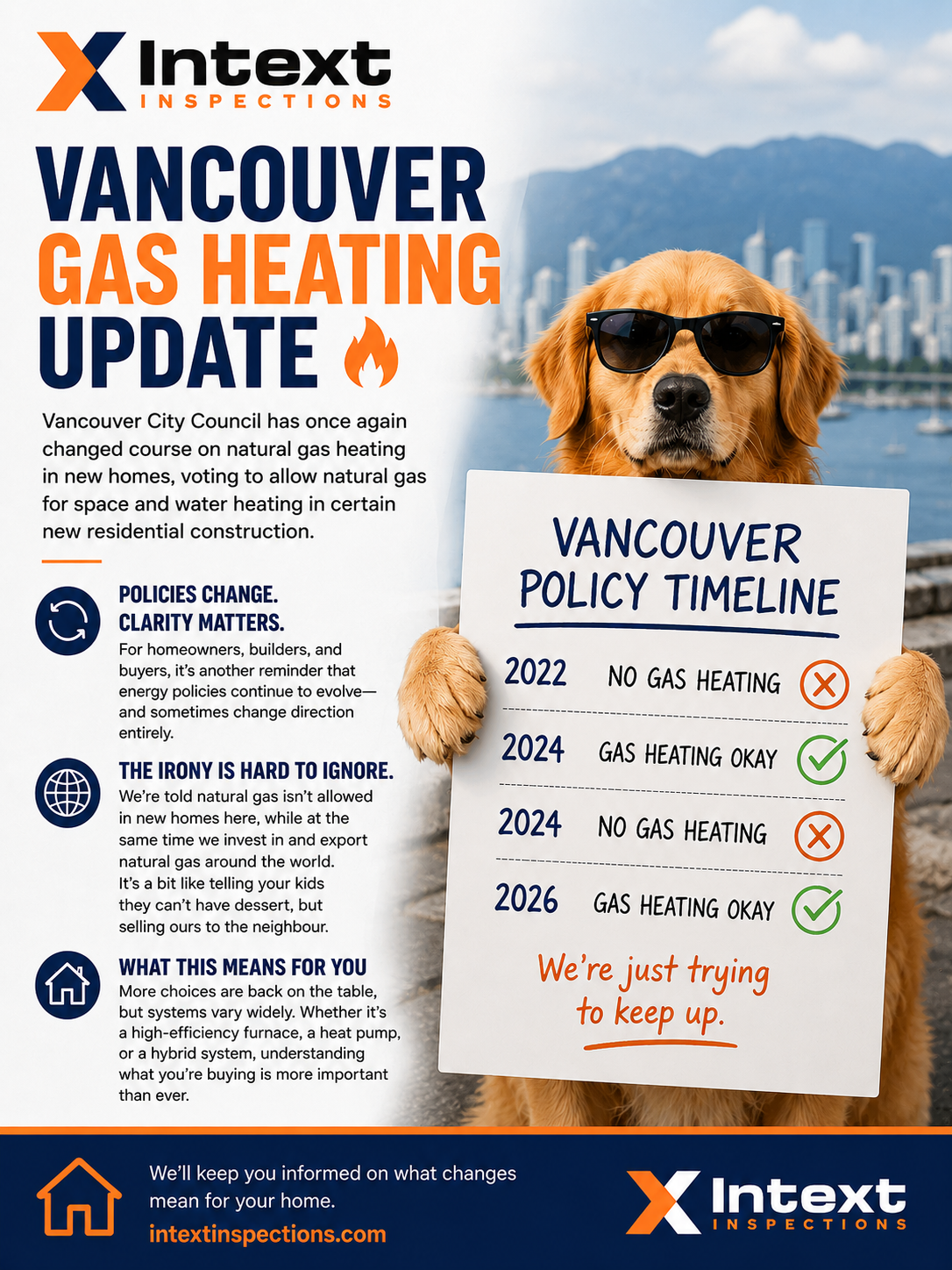

If you’re wondering whether new homes in Vancouver can have natural gas heating, you’re not alone. Vancouver’s rules regarding gas furnaces, gas boilers, and gas water heaters have changed several times over the last few years, leaving many homeowners, builders, and buyers confused about what’s actually allowed.
The recent City of Vancouver decision doesn’t mean every new home can automatically install a gas furnace, nor does it eliminate Vancouver’s energy-efficiency requirements. Instead, it changes how builders may comply with the 2025 Vancouver Building By-law (VBBL) and reopens the conversation around natural gas heating in new residential construction.
The confusion stems from the fact that Vancouver’s energy requirements include three different compliance paths for new homes:
- Prescriptive Path
- Performance Path
- Passive House Path
Each path has different requirements and can affect whether natural gas heating systems are permitted.
For several years, Vancouver’s low-carbon building policies effectively pushed most new low-rise homes toward all-electric heating systems, with heat pumps becoming the preferred solution. Natural gas space heating and domestic hot water systems became increasingly difficult to incorporate into many new residential projects.
However, recent Council decisions have signaled a shift toward providing builders with more flexibility while still maintaining energy-efficiency standards.
The most important pathway for many builders is the Performance Path. Rather than requiring specific heating equipment, this approach focuses on meeting overall energy and emissions targets through energy modelling. This means a home may be able to include natural gas heating equipment if the building’s overall performance satisfies the requirements established by the Vancouver Building By-law.
The Prescriptive Path is generally more restrictive because it requires builders to follow specific construction, insulation, mechanical, and energy-efficiency requirements. Under this approach, heating system choices are often more limited.
The third option is the Passive House Path, which allows builders to meet Vancouver’s energy requirements through internationally recognized Passive House standards. These homes are designed to achieve extremely low energy consumption through superior insulation, air sealing, and mechanical systems.
For homeowners, the most important point is that these changes apply primarily to new construction. Existing homes with natural gas furnaces, boilers, fireplaces, or water heaters are not affected by the current policy changes.
So what does this mean if you’re building a home in Vancouver?
The answer depends on which compliance path your project follows. While Vancouver continues to pursue energy-efficient construction, builders may once again have more flexibility when selecting heating systems, particularly under performance-based compliance options.
The larger issue is one of certainty. Whether a project uses a heat pump, a high-efficiency gas furnace, or a hybrid heating system, builders need stable regulations to design homes, estimate costs, and plan projects effectively. Frequent policy reversals create uncertainty for both the construction industry and future homeowners.
As Vancouver continues to refine its approach to energy-efficient housing, understanding the difference between the Prescriptive, Performance, and Passive House pathways will be essential for anyone building, buying, or investing in residential property.
Need help understanding a home’s heating system? Whether a property uses natural gas, a heat pump, electric baseboards, or a hybrid system, a professional home inspection can help buyers understand operating costs, expected maintenance, and long-term performance before they purchase.